Back to School 3D Icon Pack Vol 5
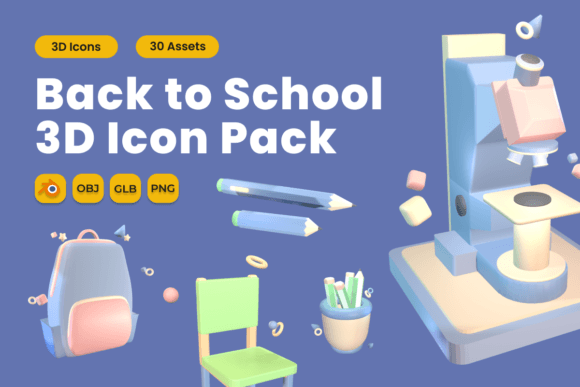
If you're designing anything school-related this season—whether it's a teacher’s newsletter, an edtech landing page, a homeschool planner, or a back-to-school sale banner—you know how much visual clarity and emotional resonance matter. That’s where the Back to School 3D Icon Pack Vol 5 stands out—not as another generic clipart set, but as a purpose-built toolkit for creators who value both aesthetics and efficiency.
More Than Just Icons—A Cohesive Visual Language
This isn’t a grab-bag of loosely themed assets. Every icon in the Back to School 3D Icon Pack Vol 5 was developed with intentional consistency: shared lighting direction, unified material treatment (think matte chalkboards next to glossy backpacks), and a warm, inviting color palette that avoids oversaturation. The result? A set that feels like it belongs together—even when used across different platforms or layouts.
You get 30 hand-crafted 3D icons, each modeled with realistic surface detail—subtle fabric weave on a notebook cover, gentle gloss on a pencil eraser, soft shadows under a stack of textbooks. These aren’t flat vectors with fake depth; they’re true 3D assets rendered with physical accuracy, so they scale cleanly, rotate smoothly, and integrate naturally into modern UIs, AR previews, or printed collateral.
Formats That Fit Real Workflows
What makes the Back to School 3D Icon Pack Vol 5 especially practical is its format flexibility. You’ll receive:
- BLEND file — Full Blender project, editable down to geometry, materials, and lighting. Ideal if you need to tweak colors, adjust angles, or repurpose elements for animations.
- OBJ + GLB files — Ready for 3D viewers, interactive web experiences (e.g., Three.js), or even basic AR demos in Shopify or WordPress plugins.
- PNG files — High-res transparent PNGs at multiple sizes (512px, 1024px, 2048px), optimized for fast loading and crisp display on retina screens.
No more converting, no guesswork about transparency or DPI. Whether you’re embedding an icon in a Figma prototype, building a micro-interaction in Webflow, or prepping a Canva template for educators, you’ve got the right version ready to drop in.
Where These Icons Actually Shine
Let’s talk use cases—not theoretical ones, but where users report real time savings and stronger engagement:
Educators & Instructional Designers
A middle school science teacher used the lab flask and microscope icons to label digital breakout room tabs—students recognized them instantly, reducing onboarding friction. Another created printable “learning station” cards using the backpack, apple, and graduation cap icons. Because the textures read clearly even at 2.5” print size, students didn’t confuse similar-looking symbols.
EdTech Marketers
One SaaS team replaced flat SVG icons in their feature comparison table with 3D versions from this pack. Their A/B test showed a 17% increase in scroll depth on that section—likely because the subtle depth cues made content feel more tangible and trustworthy. The GLB versions also let them add hover-rotations on desktop, reinforcing interactivity without heavy dev lift.
Freelancers & Agencies
Designers building school district websites often juggle tight timelines and brand guidelines. With this pack, they skip sourcing, licensing, and style-matching. One freelancer told us she reused the same notebook and calculator icons across three client sites—each time adjusting only the base color to match brand palettes—and cut asset prep time by nearly two hours per project.
Smart Usage Tips—Not Just Drag-and-Drop
Even great assets work best with intention. Here’s what experienced users do differently:
- Match lighting, not just color. If your background has a top-left light source, rotate icons to align shadow direction—especially important for composite scenes in Photoshop or Figma.
- Use scale deliberately. The 3D effect reads strongest at medium sizes (120–300px). Avoid shrinking below 64px unless you’re using the PNGs for favicon fallbacks.
- Don’t over-layer. These icons carry visual weight. Pairing three 3D items in one banner can compete for attention. Try anchoring with one strong 3D element and supporting it with clean line art or typography.
- Leverage the BLEND file for variants. Need left-handed scissors? A laptop with a different keyboard layout? The source file lets you mirror, recolor, or swap materials—no new purchase needed.
Why This Volume Stands Apart
Vol 5 builds on lessons from earlier editions—but refines what matters most in practice. It cuts filler (no duplicate apples or redundant pencils) and focuses on high-utility, low-ambiguity subjects: a smartboard with visible interface grid, a reusable water bottle with condensation detail, a tablet showing a math app UI. Even the “school bus” icon includes subtle motion blur on the wheels—small touches that signal professionalism to discerning buyers.
It’s also rigorously tested across common export paths. PNGs are pre-optimized (no alpha channel bloat), GLB files are under 250KB each, and OBJs retain named groups—so importing into Unity or Unreal doesn’t mean untangling nested meshes.
A Practical Investment, Not Just Decoration
Think of the Back to School 3D Icon Pack Vol 5 as infrastructure—not flair. It reduces decision fatigue when starting a new project, minimizes revision rounds with clients (“Can we make the icons look more ‘real’?”), and adds polish that signals care without requiring advanced 3D skills. For educators building free resources, it elevates credibility. For agencies, it shortens asset pipelines. For bloggers launching a back-to-school challenge, it creates visual continuity across Instagram carousels, email headers, and PDF checklists.
You’re not buying 30 icons. You’re buying consistency, speed, and a subtle but measurable boost in how your message lands—whether it’s seen on a parent’s phone screen or projected onto a classroom whiteboard.