Watercolor Cute Boy Back to School: A Practical Guide for Designers and Crafters
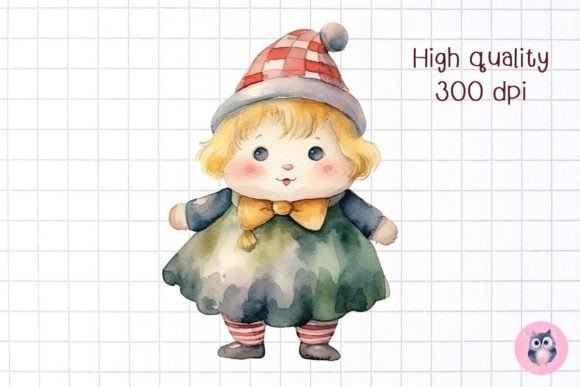
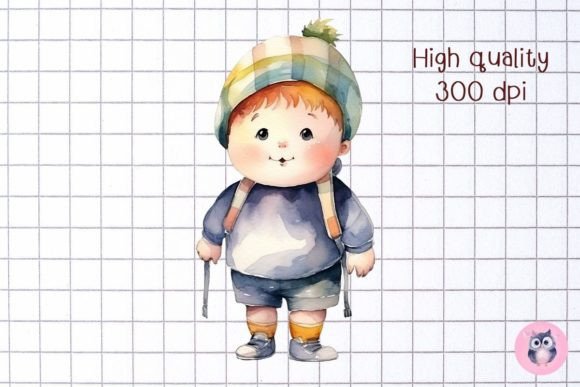
Watercolor Cute Boy Back to School is a ready-to-use digital illustration designed specifically for seasonal creative projects—especially those tied to the late-summer and early-fall transition. Unlike generic school-themed clipart or vector packs, this design centers on a softly rendered, expressive child figure in watercolor style: gentle washes, subtle texture, and a warm, approachable aesthetic. It’s not just decorative—it carries an emotional tone that resonates with nostalgia, anticipation, and gentle encouragement—qualities that matter when designing for students, teachers, parents, or educational small businesses.
What Sets This Design Apart
The distinction lies in execution and flexibility—not just subject matter. Watercolor Cute Boy Back to School delivers two high-resolution files: one PNG with full transparency and one JPG on a crisp white background (3000×3000 px, 10″×10″ at 300 DPI). That resolution supports sharp output across both small-format items like stickers and larger applications such as wall art or tote bags. The transparent PNG allows seamless layering over textures, patterns, or photos; the white-background JPG simplifies direct printing or use in platforms that don’t handle alpha channels well.
Crucially, the artwork is built for production—not just display. It’s explicitly optimized for sublimation, DTG (direct-to-garment), screen printing, inkjet transfers, and digital printing. That means color separation, edge clarity, and tonal range have been considered during creation—not retrofitted after the fact. You won’t need to manually adjust halftones or rebuild outlines for most standard workflows.
How It Compares to Other School-Themed Assets
Many school-related graphics fall into one of three categories: cartoon vectors, photorealistic stock images, or hand-drawn line art. Watercolor Cute Boy Back to School occupies a middle ground—more tactile than flat vectors, more versatile than photos, and more emotionally grounded than minimalist linework.
- Vectors offer scalability and easy recoloring but often lack depth or warmth. They’re ideal for logos or scalable signage but can feel sterile on soft goods like mugs or pillows where texture matters.
- Photographic assets provide realism but come with licensing constraints, limited editing freedom, and poor adaptability across substrates—especially when you need to isolate subjects or adjust lighting.
- Line art or doodle-style illustrations work well for journals or printable planners but may not hold up under enlargement or sublimation without visible pixelation or thin-line breakage.
In contrast, the watercolor medium here introduces organic variation—subtle granulation, soft edges, and layered pigment—that translates naturally to fabric, ceramic, and paper. It avoids the “clipart” feel while remaining accessible to non-professionals using tools like Canva or Cricut Design Space.
Real-World Use Cases and Practical Fit
This design shines where authenticity and warmth are priorities—and where production fidelity matters. Consider these scenarios:
- Small-batch apparel: Printed on cotton tees or sweatshirts via DTG, the watercolor texture reads as intentional and artisanal—not low-res or overly processed.
- Educational printables: Teachers or homeschoolers can integrate it into welcome packets, classroom posters, or student reward charts without worrying about copyright or commercial restrictions.
- Gift and stationery products: Mug decals, greeting cards, or framed prints benefit from the 10″×10″ size and clean white-background version—no cropping or background removal needed.
- Sublimation on polyester blends: Because the file includes no watermarks and uses RGB color profiles suited for dye-sub, it performs reliably on tumblers, phone cases, and performance apparel.
That said, fit depends on your goals. If you need multiple poses, gender-inclusive variations, or bilingual text integration, this single-image set won’t scale to those needs. It’s intentionally focused—not modular.
Tradeoffs to Acknowledge
No design asset is universally optimal. With Watercolor Cute Boy Back to School, the tradeoffs are mostly contextual:
- Color consistency isn’t guaranteed across devices or printers. As noted in the product details, monitor calibration and printer profiles affect how blues, pinks, and skin tones reproduce. Test prints on your target substrate before bulk production.
- No mock-ups are included. You’ll need to source or create your own presentation visuals—whether for client pitches or Etsy listings. That adds time if you rely heavily on photorealistic previews.
- It’s a single composition—not a bundle. You won’t find alternate expressions, seasonal accessories (e.g., backpacks, apples, pencils), or coordinating patterns. That’s a strength for cohesion but a limitation for variety-driven projects.
- Watercolor texture may not suit ultra-minimalist or corporate branding. Its charm lies in softness and imperfection—if your brand voice prioritizes precision, grid-based layouts, or monochrome rigor, this may feel tonally misaligned.
When It’s the Right Choice—and When It’s Not
Watercolor Cute Boy Back to School is especially appropriate when:
- You’re creating for K–5 audiences, parent-teacher associations, or boutique education brands that value approachability over formality.
- Your production method relies on sublimation or DTG—and you want to avoid costly raster-to-vector conversion or manual masking.
- You need fast turnaround on physical goods: the white-background JPG lets you upload directly to print-on-demand services without prepping layers.
- You’re balancing budget and quality—this offers professional-grade output without commissioning custom illustration.
It’s less suitable when:
- You require editable vector paths for precise resizing or path-based cutting (e.g., vinyl decal machines).
- Your project demands strict brand color matching (Pantone references aren’t provided, and RGB-to-CMYK shifts can occur).
- You’re building a long-term visual system—like a full seasonal collection—and need thematic continuity across months or grade levels.
- You’re working with clients who expect layered PSD files with adjustment layers or font access (this is a flattened raster asset).
Making an Informed Decision
Before choosing Watercolor Cute Boy Back to School—or any similar asset—consider your workflow, audience expectations, and end-use constraints. Ask yourself:
- What substrates will I print on? (Sublimation polyester behaves differently than uncoated cardstock.)
- Do I control the entire production chain—or am I handing off to a third-party printer?
- How much time do I have for prep work? (Transparent PNGs save time over background removal—but require compatible software.)
- Does the emotional resonance of the image align with my message? (A playful watercolor boy conveys different values than a bold typographic “First Day!” banner.)
There’s no universal “best” school-themed graphic—only what fits your specific context. Watercolor Cute Boy Back to School earns its place where warmth, production readiness, and thoughtful design intersect. It’s not a shortcut. It’s a considered starting point—one that respects both the craft of making and the people who’ll ultimately engage with the final piece.