Back to School Board Alphabet Font
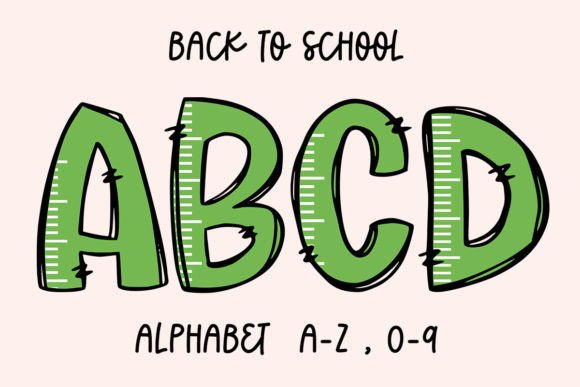
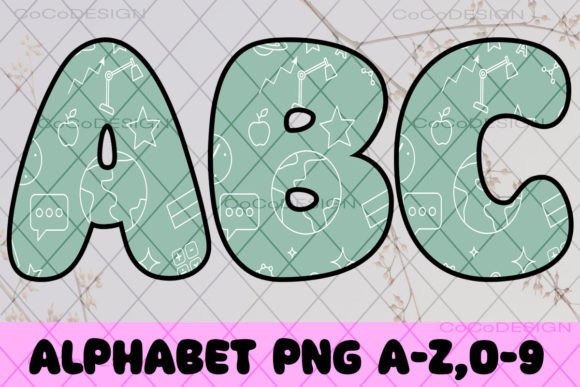
If you're designing classroom signs, personalized mugs for teachers, or custom back-to-school invitations, the Back to School Board Alphabet Font is a smart starting point — but only if you understand what you’re actually getting. This isn’t a downloadable font file you install on your computer. It’s a set of 26 high-resolution PNG files (plus numbers), each letter rendered with clean lines, chalkboard-inspired texture, and a transparent background. That distinction matters — especially if you’ve ever opened a design file expecting editable text only to find static images instead.
What This Digital Product Really Is — and Isn’t
This is a printable PNG download: no physical item ships, no font installation occurs, and no vector editing is possible. Each letter is a standalone 300 DPI raster image, optimized for sublimation printing, digital scrapbooking, web use, or print-on-demand projects. Because they’re PNGs with transparency, they layer cleanly over photos, patterns, or solid backgrounds — ideal for creating cohesive classroom décor or branded merchandise.
But here’s where confusion often starts: some buyers assume “alphabet font” means a true typeface (.TTF or .OTF) that scales infinitely without quality loss. It doesn’t. These are fixed-size raster graphics. While perfectly suited for mugs, tote bags, framed prints, or social media graphics sized at standard dimensions, they won’t behave like fonts in Canva or Adobe Illustrator when you try to stretch, warp, or kern them dynamically.
A Common Mistake: Assuming Editability Equals Flexibility
One of the most frequent oversights is downloading this set thinking you’ll be able to change colors, adjust spacing, or tweak individual strokes inside design software. You can’t — not without advanced photo editing tools like Photoshop, and even then, results are limited. Since these are flattened PNGs (not layered PSDs or vector SVGs), every adjustment requires manual masking or recoloring — time-consuming and imprecise for beginners.
For example, imagine ordering this set to create a bulletin board banner where you need “WELCOME BACK” in varying sizes. If you scale the “W” too large in Canva, it may pixelate — unlike a real font, which stays sharp at any size. The solution? Use the letters at or near their native resolution (they’re designed for standard print and sublimation workflows), and plan layouts before scaling.
Another Overlooked Detail: Sublimation Readiness Isn’t Automatic
Yes, these PNGs are labeled “sublimation-ready,” and they are — but only if your workflow supports it. That means using sublimation ink, compatible paper, and polyester-coated substrates (like ceramic mugs or aluminum blanks). Printing these onto regular copy paper or cotton t-shirts won’t yield the intended result. Worse, skipping a test print on scrap material first can waste expensive blanks and ink.
Also worth noting: because each letter has a transparent background, alignment matters. When arranging letters side-by-side in your design software, small gaps or overlaps can appear unless you use guides or snap-to-grid features. A quick tip? Place all letters on a single artboard with consistent baseline alignment before exporting your final layout.
Why File Type Confusion Leads to Real-World Frustration
Calling this an “alphabet font” is convenient marketing — but it blurs an important technical line. Fonts are software; PNGs are images. That difference affects everything from licensing (these files are for personal and small business commercial use, but *not* for redistribution or resale as fonts) to compatibility (they won’t show up in Microsoft Word’s font menu).
We’ve seen creators buy multiple similar sets — one labeled “chalkboard font,” another “school alphabet clipart” — only to realize too late they’ve duplicated effort and storage space. Before purchasing, ask yourself: Do I need scalable, editable text? Then look for SVG or OTF files. Do I need fast, consistent, print-ready letters with authentic texture? Then this Back to School Board Alphabet Font set delivers exactly that — as long as expectations align.
What to Check Before You Download
- Resolution needs: Confirm your end use matches 300 DPI output — ideal for 8x10” prints or 15oz mug wraps, less ideal for billboards or massive wall decals.
- Background preference: These include transparency, so verify your design tool supports PNG layers (most do, but older versions of PowerPoint or basic online editors sometimes flatten them unintentionally).
- Licensing scope: You’re allowed to use these on products you sell (e.g., teacher appreciation mugs), but you cannot resell the PNG files themselves or claim them as your original font design.
- File organization: You’ll receive 26 uppercase letters + numbers as individual PNGs — helpful for selective use, but less efficient if you need full words pre-assembled. Consider whether your project benefits from granular control or would save time with pre-made word templates.
Better Alternatives — and When to Choose Them
If your goal is speed and consistency across dozens of student name tags, this set shines. But if you’re building a reusable classroom website or interactive PDF where users select fonts dynamically, a true web-safe or Google Font alternative (like Chalkboard SE or KG Primary Dots) offers better flexibility and accessibility.
For educators making weekly bulletin board updates, having these letters ready to drag-and-drop into Google Slides saves hours over typing and stylizing each time. For entrepreneurs launching a back-to-school product line, pairing these with coordinating borders or icons (from the same designer, if available) ensures visual harmony without design fatigue.
Final Thought: Match the Tool to the Task
The Back to School Board Alphabet Font isn’t lesser than a font — it’s different. Its strength lies in its simplicity, texture, and plug-and-play readiness for physical and digital crafts. Where others struggle with inconsistent chalk effects or mismatched sizing, this set delivers uniformity out of the gate. Just remember: clarity about format, purpose, and limits turns a good purchase into a truly useful one.